
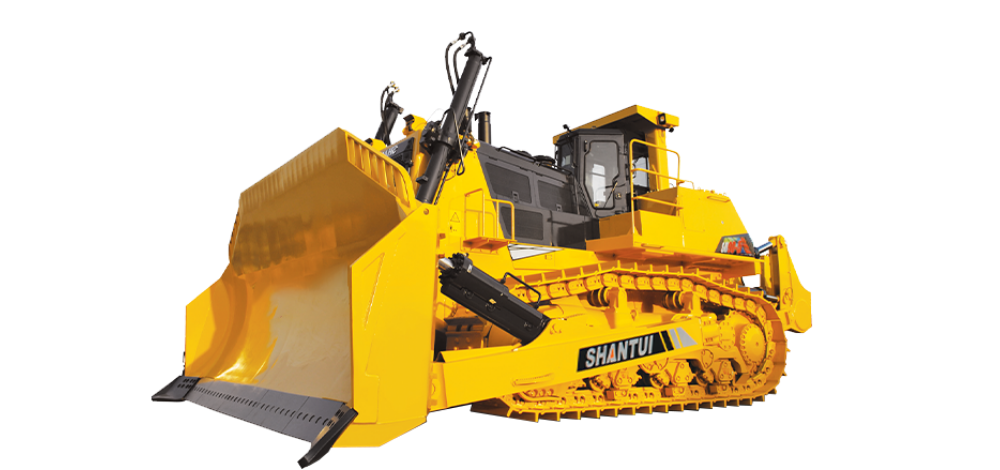
Shantui Bulldozer Reliability: A Field Review | Heavy Equipment Insights Field Reviews Shantui Bulldozer Reliability: A Field Review After Years of Real-World Use Heavy Equipment Editorial • July 17, 2026 • 6 min read If you’ve spent any time shopping the used heavy equipment market, you’ve probably run into Shantui. The Chinese manufacturer has become impossible to ignore — you’ll see Shantui equipment for sale on nearly every import dealer’s lot, often at 20–40% below the price of a comparable Caterpillar or Komatsu machine. But price alone doesn’t tell you whether a machine will still be running in five years. This review pulls together operator field experience, common failure points, and how Shantui stacks up against the brands contractors already trust, so you can decide whether a Shantui bulldozer belongs in your fleet. Who Is Shantui, Anyway? Shantui Construction Machinery traces its roots back to a state-owned Chinese manufacturer founded in 1980, and it has since grown into one of the world’s larger heavy equipment producers by volume, with bulldozers as its flagship product line. The company also builds excavators, wheel loaders, road rollers, and motor graders, but bulldozers remain what it’s best known for internationally. A key detail for reliability: Some of Shantui’s earlier and mid-range dozer designs share DNA with Komatsu platforms, a legacy of past technology-transfer agreements. That heritage shows up in the drivetrain layout and general mechanical simplicity of models like the SD16 and SD22, which is part of why long-time owners describe them as straightforward to work on. Shantui Bulldozer Reliability: What Field Experience Actually Shows This is the part most buyers actually want to know, and the honest answer is “it depends more on maintenance discipline than on the badge on the hood.” The Good News From Operators Durability: Owners who’ve run older Shantui dozers for two decades or more report that most of the trouble they’ve encountered has been ordinary wear and tear rather than catastrophic failures. Serviceability: The mechanical layout on the mid-size models (SD16/SD22 range) is simple enough that a competent bush mechanic can diagnose and fix most problems without dealer support. Structural Integrity: Undercarriage and structural components generally hold up well in rough terrain, according to job-site feedback from mining and earthmoving operations. Where Problems Show Up Overheating: Transmission overheating is one of the most commonly reported issues, particularly when operators run non-approved hydraulic fluid or skip scheduled fluid changes. Hydraulics: Sluggish blade response shows up in the same maintenance-related bucket — it’s more often a hydraulic oil or filter issue than a design flaw. Parts Risk: Parts authenticity is a recurring theme. Because Shantui parts get counterfeited in some markets, machines serviced with non-genuine components are far more prone to premature failure. Component-Level Troubleshooting On engine, transmission, and steering-clutch systems, issues follow a fairly formulaic pattern: rough running when cold usually traces back to air in the hydraulic system, fuel starvation, or filter blockage, while power loss when hot points toward the torque converter, gearbox, steering clutch, or brake system. The practical takeaway: Shantui reliability is real, but it’s conditional. Stick to the recommended 250-hour initial service and 500-hour comprehensive inspection intervals, use genuine parts and approved hydraulic oil, and the failure modes people complain about mostly disappear. Shantui Machinery Lineup: Where the SD22 and SD90 Fit Shantui’s dozer range spans from compact 17-ton machines up to some genuinely enormous mining-class iron, and understanding where a given model sits helps set realistic expectations. SD22 Shantui SD22 (The Workhorse) This is the workhorse of the mid-range lineup, running roughly a 162 kW engine and an operating weight around 23 tons. It’s positioned as the versatile all-rounder: strong enough for foundation and earthmoving work, but still maneuverable and simple enough for smaller contractors to own and maintain without a large service department. If you’re looking at Shantui heavy equipment for the first time, the SD22 is usually the sensible entry point. SD90 Shantui SD90 (The Heavyweight Flagship) This is the other end of the spectrum entirely. The SD90-C5 is Shantui’s flagship large-class bulldozer, tipping the scales at over 106 tonnes with a Cummins-sourced engine rated around 708 kW (roughly 950 hp), putting it in the same weight class as machines like the Caterpillar D11. It’s built for large open-pit mines and major earthmoving projects, not general contracting work. Features like an electronically controlled transmission and full-cab monitoring reflect that it’s aimed at large fleet operators rather than owner-operators. Between those two sits the rest of the range — SD16 for light work, SD32 for large-scale mining and earthmoving that doesn’t need SD90-class size — giving buyers a genuinely broad set of options depending on job scope. Shantui vs Caterpillar: The Real Trade-Off This comparison comes up constantly, and it’s worth being direct about it rather than picking a side. Category Caterpillar Wins Shantui Wins Technology & Control More advanced electronic grading and blade-control systems. Mechanical simplicity that makes field repairs easier when isolated. Financials Stronger resale value and a predictable used-equipment market. Purchase price is routinely 20–40% lower than an equivalent Cat. Support Network Deeper dealer and parts networks in most Western markets. Lower cost-per-hour of ownership for self-reliant operators. The honest summary most experienced buyers land on: if your operation is running high-production mining or infrastructure work with a big service budget and needs the latest automated grading tech, Caterpillar’s ecosystem still generally justifies the premium. If you’re a smaller contractor or working in a region where you’ll be doing your own wrenching, a Shantui bulldozer can do the same job for meaningfully less money, provided you commit to proper maintenance. Buying Used Shantui Equipment: What to Check First If you’re shopping listings for used Shantui equipment, a few checks go a long way toward avoiding reliability headaches: ✓ Verify Service History: Ask for maintenance records, specifically whether the 250-hour and 500-hour service intervals were followed. ✓ Check Parts Authenticity: A machine serviced exclusively with genuine Shantui parts is a materially safer bet than one with an unknown parts

Heavy Earthmoving Dynamics: A Technical Breakdown of the Shantui SD32 vs. Caterpillar D8
Heavy Earthmoving Dynamics: A Technical Breakdown of the Shantui SD32 vs. Caterpillar D8 An Engineering Verification and Comparison Based on Official Manufacturer Specifications In the heavy industrial crawler tractor segment, asset procurement hinges on matching raw drawbar pull with field maintainability. The industry standard is often set by the Caterpillar D8 series, heavily lauded for its structural rigidity and differential steering systems. However, engineering procurement teams evaluating global mine-site cost-per-ton metrics are shifting focus to the Shantui SD32. The Shantui SD32 represents a robust, highly mechanical engineering approach that prioritizes heavy displacement, high mechanical torque multiplication, and modular field maintenance, contrasting with the ultra-complex electronic topology of the modern Cat D8. 1. Powertrain Mechanics and Torque Curves A bulldozer’s ability to maintain forward ground momentum while cutting through highly dense structural formations relies entirely on its engine torque reserve. The Caterpillar D8 Configuration: Typically features the Cat C15 engine. The C15 uses high-pressure common-rail fuel injection paired with twin-turbocharging systems to meet strict Stage V emissions regulations. The engine relies heavily on an Electronic Control Module (ECM) to adjust fuel injection timing dynamically under shifting engine loads. The Shantui SD32 Configuration: Implements a heavy-duty Cummins engine platform. It provides a rated net output power of 257 kW (approx. 345 HP) at 2000 rpm. This configuration aligns with EU Stage II emissions parameters, delivering an optimal balance of pure raw mechanical output without sensitive, failure-prone electronic networks. The engineering contrast is clear: Cat relies on electronic management to extract high power density from a narrower thermal window. Shantui uses a massive engine displacement layout. The Cummins engine platform delivers immense peak torque at low engine speeds. It easily tolerates variations in fuel quality and high-sulfur diesel, making it uniquely reliable for remote operations where clean fuel infrastructures are unavailable. 2. Kinetic Power Transmission: Planetary Gears vs. High-Drive Efficiency How kinetic energy moves from the flywheel to the final drive sprockets defines these machines’ distinct mechanical philosophies: Technical Metric Shantui SD32 Spec Profile (Official Global Data) Caterpillar D8 Metric Profile Engine Brand Cummins Cat C15 Rated Power / Speed 257 kW (345 HP) @ 2000 rpm Approx. 264 kW (354 HP) @ 1900 rpm Overall Weight 39,700 kg Approx. 39,800 kg Ground Contact Length 3,150 mm Approx. 3,210 mm Track Center Distance 2,140 mm Approx. 2,080 mm Fuel Tank Capacity 640 Liters Approx. 600-620 Liters Available Blade Options Straight tilting blade, Angle Blade, Semi-U blade Straight tilt, Universal, Semi-U Semi-U Blade Capacity 9.0 m³ Approx. 10.3 m³ The Transmissions and Final Drives The Cat D8 utilizes an elevated sprocket design (“High-Drive”). This layout isolates the final drive planetary gears from ground-shock loads caused by track impact. However, it requires a convoluted, non-linear track geometry that adds friction points, wear tracks, and multiple idler systems. The Shantui SD32 utilizes a classic low-drive layout paired with Shantui’s self-developed, high-efficiency transmission. The final drive consists of a straight-line speed reduction spur gear mechanism. This rigid engineering pathway delivers a highly linear power transfer. Under extreme drawbar resistance, the low-drive setup provides reliable mechanical torque multiplication directly into the track rails with fewer internal frictional losses. 3. Hydraulic Kinematics and Steering Dynamics Steering system design determines how effectively a dozer moves material through complex turns: Caterpillar D8: Utilizes a sophisticated electronic differential steering system. This setup keeps power flowing to both tracks during a turn, resulting in excellent maneuvering speeds. However, it requires complex dual-pump hydraulic loop routing and precise calibration. Shantui SD32: Relies on a robust, highly reliable multi-disc hydraulic steering clutch paired with a boosted hydraulic braking system. The layout of filter elements and hydraulic components on the SD32 is optimized for rapid diagnostic access via the openable side guards. This straightforward configuration allows operators to execute precise, high-load pivot turns. Because it uses mechanical-hydraulic linkages rather than proportional electronic valves, the system is highly resistant to fluid contamination and can be fully serviced in the field using basic hydraulic tools. Undercarriage Note: Shantui is an industry authority in track metallurgy. The SD32 features Shantui\’s specialized “four wheels and one track” chassis components, utilizing a ground contact length of 3,150 mm and adaptable track shoe widths ranging from 560 mm to 710 mm. This structural engineering platform delivers maximum traction and greater operational efficiency under severe heavy-rock mining applications. Total Cost of Ownership (TCO) and Maintainability Analysis For fleet managers tracking total lifecycle costs, the Shantui SD32 offers clear operational advantages over its premium competitor: 1. Optimized Shift Autonomy With an integrated fuel cell capacity of 640 Liters, the SD32 maximizes active run times during deep production shifts. Fleet teams can minimize the deployment of refuel tenders on large sites, driving down localized logistics overheads. Combined with highly versatile attachment choices—including the high-volume 9.0 m³ Semi-U blade, the 7.2 m³ Straight Tilting blade, or the 4.8 m³ Angle blade—the machine can be precisely tailored to material density profiles to limit fuel-burn inefficiency. 2. Eliminating Factory Diagnostics Wait Times A modern Cat D8 relies on a dense network of digital sensors monitoring everything from exhaust treatment systems to hydraulic pressure variances. A single sensor fault can put the machine into “derate” safety mode, completely stopping production until a specialized field technician arrives with proprietary software. The Shantui SD32 avoids electronic gatekeeping entirely. Its mechanical linkages, spacious openable side guards, and analog-over-digital warning systems allow field mechanics to quickly diagnose and fix faults, minimizing unscheduled downtime. 3. Lower Initial Capital Commitment The upfront purchase price of a Shantui SD32 is typically significantly lower than a comparably equipped Cat D8. This drastically reduces initial capital risk, financing fees, and insurance premiums. Combined with its reliable engineering matrix and modular layout, the SD32 delivers a highly profitable cost-per-cubic-meter ratio, making it an ideal choice for high-volume earthmoving projects.