
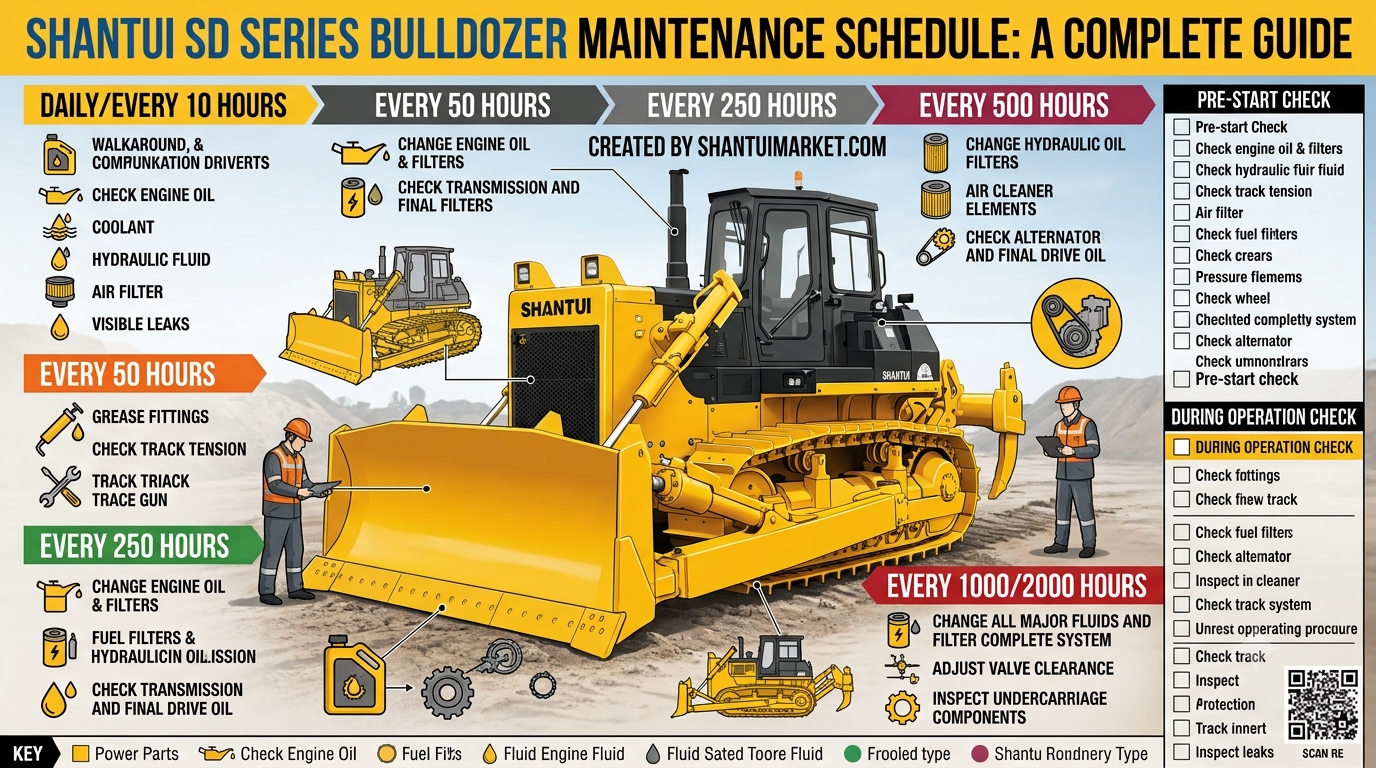
Shantui SD Series Bulldozer Maintenance Schedule: Complete Engineering Guide Field Engineering Insights Shantui SD Series Bulldozer Maintenance Schedule: A Complete Guide Published by Heavy Equipment Technical Brief • Technical Expert Series In heavy earthmoving and high-bulk earth-shifting operations, few machines match the structural resilience and torque density of the Shantui SD Series—specifically the ubiquitous SD16, SD22, and SD32 platforms. Powered by field-proven Weichai or Cummins powerplants and driven through advanced hydraulic torque converters and planetary power-shift transmissions, these machines are engineered for brutal duty cycles. However, mechanical resilience is entirely dependent on rigid fluid dynamics, thermodynamic management, and tribological care. Waiting for a hydraulic line to burst or a final drive to lock up is an expensive way to run an operation. This guide bypasses generalities to deliver an aggressive, technically precise maintenance architecture for the Shantui SD Series, focusing on specific engineering friction points, clearance profiles, and fluid specs. 1. The Primary Tribological Architecture: Fluid Specifications Before executing any maintenance interval, you must ensure that lubricants match the extreme shear stresses and thermal ranges encountered by planetary gear trains and high-pressure hydraulic circuits. Shantui architectures utilize dedicated compartments requiring distinct additive packages: Compartment / System Fluid Classification Viscosity Grade (Ambient) Key Technical Metric / Additive Profile Diesel Engine API CH-4 / CI-4 Heavy Duty 15W-40 (-15°C to 40°C) High TBN (Total Base Number) for sulfur-heavy fuel handling. Hydraulic System ISO L-HM Anti-Wear Hydraulic Fluid ISO VG 46 / VG 68 Minimum 100 Viscosity Index; zinc-based anti-wear (AW) chemistry. Torque Converter & Transmission Caterpillar TO-4 / Allison C-4 Spec SAE 10W or SAE 30 Controlled friction coefficients for dynamic clutch discs; zero modifiers. Final Drive & Bevel Gear Cases API GL-5 Heavy Duty Gear Oil SAE 85W-140 / 80W-90 Extreme Pressure (EP) additives for shock loading and spur-gear protection. ⚠️ Engineering Warning: TO-4 vs. GL-5 Compatibility Failure Never introduce API GL-5 gear oil into the power-shift transmission or central steering clutch compartments. The sulfur-phosphorus EP additives in GL-5 will rapidly corrode the bronze and copper-alloy sintered friction discs within the clutch packs, inducing premature glazing, slippage, and eventual catastrophic dynamic lock-up. 2. Operational Intervals and Technical Actions Daily / 10-Hour Shift Inspections (Pre-Start & Warm-Up) Daily maintenance is not a “walkaround”; it is a localized inspection to prevent systemic failures caused by cold-start starvation or slow fluid leakage. Track Tension Visual Assessment: Inspect the sag of the track chain between the carrier roller and the front idler. Visual sag should measure between 30mm and 50mm. If sag exceeds 50mm, the track will “snake,” accelerating wear on track guide links and sprocket teeth. Hydraulic and Transmission Sump Checks: Verify levels via the sight glasses on the right-hand chassis flank. Fluid must be checked at operating temperature with the blade and ripper dropped flat to the ground (ensuring zero pressure in the cylinders). Engine Intake Air Cleaner Dust Valve: Squeeze the rubber vacuator valve on the Donaldson-style air cleaner housing to eject accumulated particulate matter. Monitor the restriction indicator on the dash panel; if the red signal latches, immediate primary element servicing is required. 50-Hour Operational Interval (Weekly Hard Check) Cross-Shaft / Equalizer Bar Pin Lubrication: The equalizer bar pin experiences massive oscillatory loads. Pump lithium-based grease (NLGI No. 2 with 3% Molybdenum Disulfide) into the center pin housing and end-pin bush assemblies until clean grease purges from the lip seals. Drive Shaft Spline and Universal Joints: Inject grease into the main drive shaft slip joint and U-joints. A dry slip joint transfers axial thrust loads straight into the torque converter output bearing, causing premature seal weeping and bearing pitting. 250-Hour Critical Servicing (First Major PM Boundary) The 250-hour mark is where chemical degradation of engine oil becomes a factor due to soot loading and shear breakdown. Engine Lubrication Evacuation: Drain engine oil hot. Extract the spin-on full-flow filters and bypass filters. Inspect the filter pleats for non-ferrous bronze flakes (indicating wrist pin/rod bearing wear) or magnetic iron filings (indicating ring/liner wear). Final Drive Oil Level and Magnetic Plug Inspection: Remove the oil level plug on both the left and right final drive cases. The oil should be level with the bottom of the plug threads. Remove the magnetic drain plug to inspect for micro-shaving accumulation. Fine gray paste is normal; distinct metal chips indicate a failing planetary sun gear or outer bearing cage. Alternator and Fan Belt Tensioning: Apply a force of F = 40 N perpendicular to the midpoint of the longest belt span. Deflection should fall rigidly within 10mm to 15mm. Out-of-spec tension causes water pump bearing failure or belt slippage, leading to localized thermal spikes in the cylinder head. 3. Advanced 500-Hour and 1000-Hour Preventive Maintenance 500-Hour Fluid and Filtration Service Transmission and Torque Converter Filter Replacement: Replace the high-pressure spin-on filter element located in the transmission compartment. Clean the internal magnetic suction strainer basket. The suction strainer captures larger metallic scale before it reaches the charging pump. If this strainer fills with friction material, the pump will cavitate, lowering main clutch engagement pressure (P_clutch < 2.0 MPa) and causing dynamic slipping. Fuel System Multi-Stage Filtration: Replace both the primary fuel-water separator element and the secondary fine particulate fuel filter. Shantui units running Weichai WD12 or Cummins NT855 engines are highly sensitive to water contamination, which causes rapid cavitation and erosion of the mechanical injector nozzles. 1000-Hour Comprehensive Component Refurbishment At 1000 hours, we manage structural oil changes and internal mechanical clearances: Transmission and Bevel Gear Case Fluid Exchange: Drain the entire central chassis reservoir. Clean the magnetic strainers thoroughly using mineral spirits. Refill with fresh SAE 30 TO-4 fluid. Final Drive Fluid Evacuation: Flush both final drive cases to clear out micro-debris generated by the heavy spur and planetary reduction gears. Refill with SAE 85W-140 GL-5 gear oil. Engine Valve Lash Calibration: On cold engines, remove the rocker covers and mechanically check valve clearances using a feeler gauge. Adjust the clearance to precise factory tolerances: Intake Valves: 0.40 mm Exhaust Valves: 0.65 mm Proper lash ensures

Heavy Earthmoving Dynamics: A Technical Breakdown of the Shantui SD32 vs. Caterpillar D8
Heavy Earthmoving Dynamics: A Technical Breakdown of the Shantui SD32 vs. Caterpillar D8 An Engineering Verification and Comparison Based on Official Manufacturer Specifications In the heavy industrial crawler tractor segment, asset procurement hinges on matching raw drawbar pull with field maintainability. The industry standard is often set by the Caterpillar D8 series, heavily lauded for its structural rigidity and differential steering systems. However, engineering procurement teams evaluating global mine-site cost-per-ton metrics are shifting focus to the Shantui SD32. The Shantui SD32 represents a robust, highly mechanical engineering approach that prioritizes heavy displacement, high mechanical torque multiplication, and modular field maintenance, contrasting with the ultra-complex electronic topology of the modern Cat D8. 1. Powertrain Mechanics and Torque Curves A bulldozer’s ability to maintain forward ground momentum while cutting through highly dense structural formations relies entirely on its engine torque reserve. The Caterpillar D8 Configuration: Typically features the Cat C15 engine. The C15 uses high-pressure common-rail fuel injection paired with twin-turbocharging systems to meet strict Stage V emissions regulations. The engine relies heavily on an Electronic Control Module (ECM) to adjust fuel injection timing dynamically under shifting engine loads. The Shantui SD32 Configuration: Implements a heavy-duty Cummins engine platform. It provides a rated net output power of 257 kW (approx. 345 HP) at 2000 rpm. This configuration aligns with EU Stage II emissions parameters, delivering an optimal balance of pure raw mechanical output without sensitive, failure-prone electronic networks. The engineering contrast is clear: Cat relies on electronic management to extract high power density from a narrower thermal window. Shantui uses a massive engine displacement layout. The Cummins engine platform delivers immense peak torque at low engine speeds. It easily tolerates variations in fuel quality and high-sulfur diesel, making it uniquely reliable for remote operations where clean fuel infrastructures are unavailable. 2. Kinetic Power Transmission: Planetary Gears vs. High-Drive Efficiency How kinetic energy moves from the flywheel to the final drive sprockets defines these machines’ distinct mechanical philosophies: Technical Metric Shantui SD32 Spec Profile (Official Global Data) Caterpillar D8 Metric Profile Engine Brand Cummins Cat C15 Rated Power / Speed 257 kW (345 HP) @ 2000 rpm Approx. 264 kW (354 HP) @ 1900 rpm Overall Weight 39,700 kg Approx. 39,800 kg Ground Contact Length 3,150 mm Approx. 3,210 mm Track Center Distance 2,140 mm Approx. 2,080 mm Fuel Tank Capacity 640 Liters Approx. 600-620 Liters Available Blade Options Straight tilting blade, Angle Blade, Semi-U blade Straight tilt, Universal, Semi-U Semi-U Blade Capacity 9.0 m³ Approx. 10.3 m³ The Transmissions and Final Drives The Cat D8 utilizes an elevated sprocket design (“High-Drive”). This layout isolates the final drive planetary gears from ground-shock loads caused by track impact. However, it requires a convoluted, non-linear track geometry that adds friction points, wear tracks, and multiple idler systems. The Shantui SD32 utilizes a classic low-drive layout paired with Shantui’s self-developed, high-efficiency transmission. The final drive consists of a straight-line speed reduction spur gear mechanism. This rigid engineering pathway delivers a highly linear power transfer. Under extreme drawbar resistance, the low-drive setup provides reliable mechanical torque multiplication directly into the track rails with fewer internal frictional losses. 3. Hydraulic Kinematics and Steering Dynamics Steering system design determines how effectively a dozer moves material through complex turns: Caterpillar D8: Utilizes a sophisticated electronic differential steering system. This setup keeps power flowing to both tracks during a turn, resulting in excellent maneuvering speeds. However, it requires complex dual-pump hydraulic loop routing and precise calibration. Shantui SD32: Relies on a robust, highly reliable multi-disc hydraulic steering clutch paired with a boosted hydraulic braking system. The layout of filter elements and hydraulic components on the SD32 is optimized for rapid diagnostic access via the openable side guards. This straightforward configuration allows operators to execute precise, high-load pivot turns. Because it uses mechanical-hydraulic linkages rather than proportional electronic valves, the system is highly resistant to fluid contamination and can be fully serviced in the field using basic hydraulic tools. Undercarriage Note: Shantui is an industry authority in track metallurgy. The SD32 features Shantui\’s specialized “four wheels and one track” chassis components, utilizing a ground contact length of 3,150 mm and adaptable track shoe widths ranging from 560 mm to 710 mm. This structural engineering platform delivers maximum traction and greater operational efficiency under severe heavy-rock mining applications. Total Cost of Ownership (TCO) and Maintainability Analysis For fleet managers tracking total lifecycle costs, the Shantui SD32 offers clear operational advantages over its premium competitor: 1. Optimized Shift Autonomy With an integrated fuel cell capacity of 640 Liters, the SD32 maximizes active run times during deep production shifts. Fleet teams can minimize the deployment of refuel tenders on large sites, driving down localized logistics overheads. Combined with highly versatile attachment choices—including the high-volume 9.0 m³ Semi-U blade, the 7.2 m³ Straight Tilting blade, or the 4.8 m³ Angle blade—the machine can be precisely tailored to material density profiles to limit fuel-burn inefficiency. 2. Eliminating Factory Diagnostics Wait Times A modern Cat D8 relies on a dense network of digital sensors monitoring everything from exhaust treatment systems to hydraulic pressure variances. A single sensor fault can put the machine into “derate” safety mode, completely stopping production until a specialized field technician arrives with proprietary software. The Shantui SD32 avoids electronic gatekeeping entirely. Its mechanical linkages, spacious openable side guards, and analog-over-digital warning systems allow field mechanics to quickly diagnose and fix faults, minimizing unscheduled downtime. 3. Lower Initial Capital Commitment The upfront purchase price of a Shantui SD32 is typically significantly lower than a comparably equipped Cat D8. This drastically reduces initial capital risk, financing fees, and insurance premiums. Combined with its reliable engineering matrix and modular layout, the SD32 delivers a highly profitable cost-per-cubic-meter ratio, making it an ideal choice for high-volume earthmoving projects.