
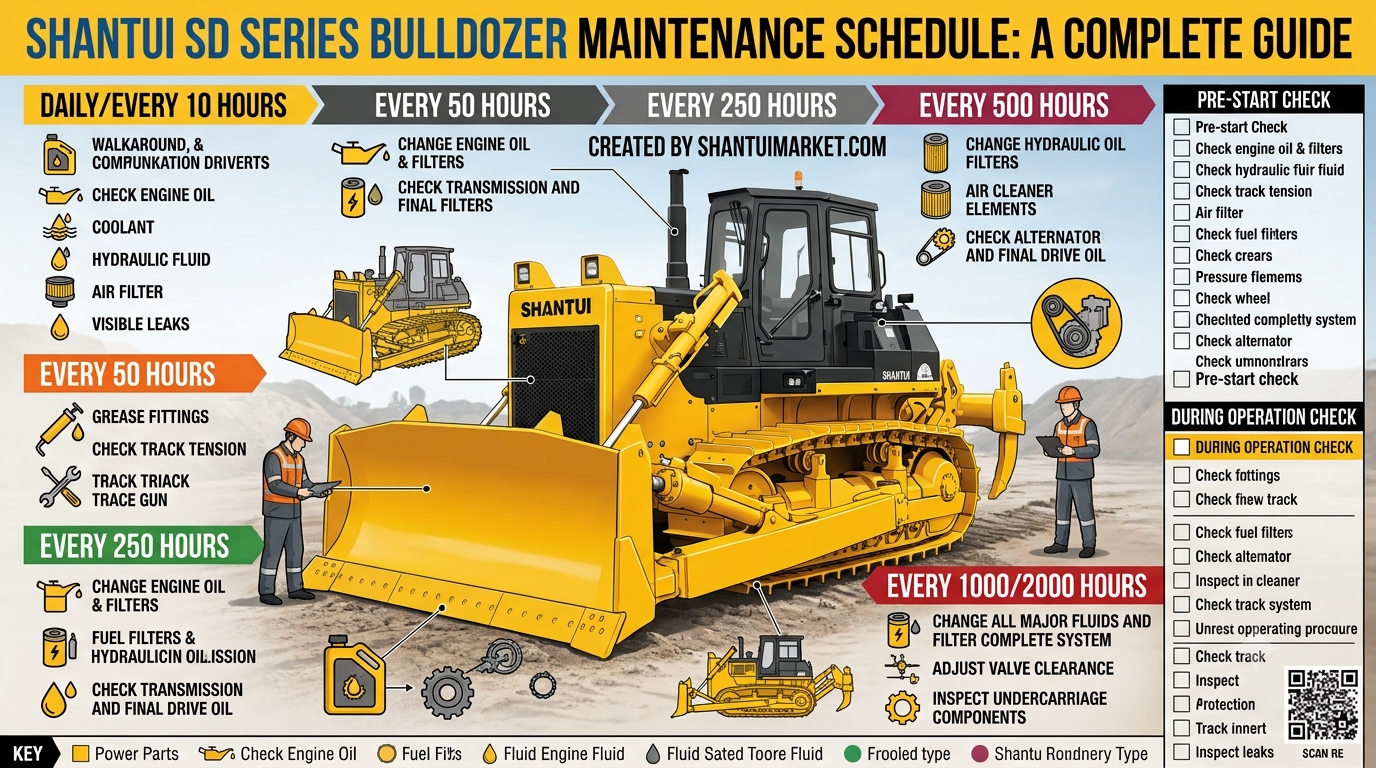
Shantui SD Series Bulldozer Maintenance Schedule: A Complete Guide
In heavy earthmoving and high-bulk earth-shifting operations, few machines match the structural resilience and torque density of the Shantui SD Series—specifically the ubiquitous SD16, SD22, and SD32 platforms. Powered by field-proven Weichai or Cummins powerplants and driven through advanced hydraulic torque converters and planetary power-shift transmissions, these machines are engineered for brutal duty cycles. However, mechanical resilience is entirely dependent on rigid fluid dynamics, thermodynamic management, and tribological care.
Waiting for a hydraulic line to burst or a final drive to lock up is an expensive way to run an operation. This guide bypasses generalities to deliver an aggressive, technically precise maintenance architecture for the Shantui SD Series, focusing on specific engineering friction points, clearance profiles, and fluid specs.
1. The Primary Tribological Architecture: Fluid Specifications
Before executing any maintenance interval, you must ensure that lubricants match the extreme shear stresses and thermal ranges encountered by planetary gear trains and high-pressure hydraulic circuits. Shantui architectures utilize dedicated compartments requiring distinct additive packages:
| Compartment / System | Fluid Classification | Viscosity Grade (Ambient) | Key Technical Metric / Additive Profile |
|---|---|---|---|
| Diesel Engine | API CH-4 / CI-4 Heavy Duty | 15W-40 (-15°C to 40°C) | High TBN (Total Base Number) for sulfur-heavy fuel handling. |
| Hydraulic System | ISO L-HM Anti-Wear Hydraulic Fluid | ISO VG 46 / VG 68 | Minimum 100 Viscosity Index; zinc-based anti-wear (AW) chemistry. |
| Torque Converter & Transmission | Caterpillar TO-4 / Allison C-4 Spec | SAE 10W or SAE 30 | Controlled friction coefficients for dynamic clutch discs; zero modifiers. |
| Final Drive & Bevel Gear Cases | API GL-5 Heavy Duty Gear Oil | SAE 85W-140 / 80W-90 | Extreme Pressure (EP) additives for shock loading and spur-gear protection. |
Never introduce API GL-5 gear oil into the power-shift transmission or central steering clutch compartments. The sulfur-phosphorus EP additives in GL-5 will rapidly corrode the bronze and copper-alloy sintered friction discs within the clutch packs, inducing premature glazing, slippage, and eventual catastrophic dynamic lock-up.
2. Operational Intervals and Technical Actions
Daily / 10-Hour Shift Inspections (Pre-Start & Warm-Up)
Daily maintenance is not a “walkaround”; it is a localized inspection to prevent systemic failures caused by cold-start starvation or slow fluid leakage.
- Track Tension Visual Assessment: Inspect the sag of the track chain between the carrier roller and the front idler. Visual sag should measure between 30mm and 50mm. If sag exceeds 50mm, the track will “snake,” accelerating wear on track guide links and sprocket teeth.
- Hydraulic and Transmission Sump Checks: Verify levels via the sight glasses on the right-hand chassis flank. Fluid must be checked at operating temperature with the blade and ripper dropped flat to the ground (ensuring zero pressure in the cylinders).
- Engine Intake Air Cleaner Dust Valve: Squeeze the rubber vacuator valve on the Donaldson-style air cleaner housing to eject accumulated particulate matter. Monitor the restriction indicator on the dash panel; if the red signal latches, immediate primary element servicing is required.
50-Hour Operational Interval (Weekly Hard Check)
- Cross-Shaft / Equalizer Bar Pin Lubrication: The equalizer bar pin experiences massive oscillatory loads. Pump lithium-based grease (NLGI No. 2 with 3% Molybdenum Disulfide) into the center pin housing and end-pin bush assemblies until clean grease purges from the lip seals.
- Drive Shaft Spline and Universal Joints: Inject grease into the main drive shaft slip joint and U-joints. A dry slip joint transfers axial thrust loads straight into the torque converter output bearing, causing premature seal weeping and bearing pitting.
250-Hour Critical Servicing (First Major PM Boundary)
The 250-hour mark is where chemical degradation of engine oil becomes a factor due to soot loading and shear breakdown.
- Engine Lubrication Evacuation: Drain engine oil hot. Extract the spin-on full-flow filters and bypass filters. Inspect the filter pleats for non-ferrous bronze flakes (indicating wrist pin/rod bearing wear) or magnetic iron filings (indicating ring/liner wear).
- Final Drive Oil Level and Magnetic Plug Inspection: Remove the oil level plug on both the left and right final drive cases. The oil should be level with the bottom of the plug threads. Remove the magnetic drain plug to inspect for micro-shaving accumulation. Fine gray paste is normal; distinct metal chips indicate a failing planetary sun gear or outer bearing cage.
- Alternator and Fan Belt Tensioning: Apply a force of F = 40 N perpendicular to the midpoint of the longest belt span. Deflection should fall rigidly within 10mm to 15mm. Out-of-spec tension causes water pump bearing failure or belt slippage, leading to localized thermal spikes in the cylinder head.
3. Advanced 500-Hour and 1000-Hour Preventive Maintenance
500-Hour Fluid and Filtration Service
- Transmission and Torque Converter Filter Replacement: Replace the high-pressure spin-on filter element located in the transmission compartment. Clean the internal magnetic suction strainer basket. The suction strainer captures larger metallic scale before it reaches the charging pump. If this strainer fills with friction material, the pump will cavitate, lowering main clutch engagement pressure (P_clutch < 2.0 MPa) and causing dynamic slipping.
- Fuel System Multi-Stage Filtration: Replace both the primary fuel-water separator element and the secondary fine particulate fuel filter. Shantui units running Weichai WD12 or Cummins NT855 engines are highly sensitive to water contamination, which causes rapid cavitation and erosion of the mechanical injector nozzles.
1000-Hour Comprehensive Component Refurbishment
At 1000 hours, we manage structural oil changes and internal mechanical clearances:
- Transmission and Bevel Gear Case Fluid Exchange: Drain the entire central chassis reservoir. Clean the magnetic strainers thoroughly using mineral spirits. Refill with fresh SAE 30 TO-4 fluid.
- Final Drive Fluid Evacuation: Flush both final drive cases to clear out micro-debris generated by the heavy spur and planetary reduction gears. Refill with SAE 85W-140 GL-5 gear oil.
- Engine Valve Lash Calibration: On cold engines, remove the rocker covers and mechanically check valve clearances using a feeler gauge. Adjust the clearance to precise factory tolerances:
- Intake Valves: 0.40 mm
- Exhaust Valves: 0.65 mm
4. 2000-Hour Lifecycle Overhaul: Deep Structural Systems
The 2000-hour mark is a critical milestone for heavy earthmovers. At this point, fluids that have undergone hundreds of thermal cycles must be replaced, and hydraulic circuits must be evaluated.
Hydraulic Sump Evacuation and Flushing
Drain the main hydraulic tank completely. Remove the large access plate to wipe down the internal tank walls, removing any settled varnish or sludge. Replace the pilot filter and the main return filter element. Visually check the suction line hose from the tank to the main hydraulic pump; if the hose feels soft or shows external cracking, replace it to prevent inner-liner collapse, which will instantly starve and destroy the main implement pump.
Cooling System Total De-scaling and Flush
Drain the glycol solution. If scale buildup is visible on the radiator core tubes, introduce a chemical de-scaler. Flush with clean water before refilling with a 50/50 Heavy-Duty Extended Life Coolant (ELC) mix. Ensure the coolant contains adequate SCAs (Supplemental Coolant Additives) to form a protective layer on the outer walls of the wet cylinder liners, which prevents cavitation-induced liner perforation.
5. Shantui Undercarriage Engineering: Wear Limits and Adjustments
The undercarriage accounts for roughly 50% of a bulldozer’s total lifetime maintenance costs. Managing track geometry is non-negotiable for low operating costs.
Track Tension Adjustment Protocol
Track tensioning on the Shantui SD Series is hydraulic, managed via a grease cylinder paired with a heavy-duty recoil spring assembly. To adjust:
- Locate the adjustment inspection window on the track roller frame side-cover.
- Using a manual or pneumatic grease gun, pump high-pressure lithium grease into the grease valve nipple. This forces the tension cylinder piston outward, pushing the front idler forward and reducing track sag.
- If the track is overtightened, carefully back out the grease discharge valve no more than 1 to 1.5 turns to allow grease to bleed back out into the valve cavity.
Warning: The grease within this cylinder is pressurized by the massive recoil spring. Never back the valve completely out, as it can project outward with dangerous force.
Wear Limit Matrix for Rebuilding
| Component | Standard Dimension | Service Limit (Wear Limit) | Engineering Action Required |
|---|---|---|---|
| Link Pitch (SD16) | 203.2 mm | 206.5 mm | Internal pin and bushing wear; pins and bushings must be turned 180° or replaced. |
| Grouser Shoe Height | 65.0 mm | 25.0 mm | Severe traction loss and structural bending risk; weld on replacement grouser bars or replace shoes. |
| Track Roller Diameter | 200.0 mm | 182.0 mm | Flange-to-pin clearance compromised; rebuild roller surface via automated hard-facing welding or replace. |
| Carrier Roller Diameter | 190.0 mm | 172.0 mm | Replace assembly; excessive wear drops the track chain onto the frame, causing accelerated link wear. |
Summary Architecture for Field Fleet Management
Executing this maintenance schedule precisely transforms your maintenance strategy from reactive to predictive. By treating oil analysis as a diagnostic tool at every 250-hour increment and sticking strictly to scheduled teardowns and adjustments, fleet owners can easily push a Shantui SD system past its standard design life. This practice minimizes unscheduled downtime and maximizes the return on investment for both the powertrain and undercarriage components.