
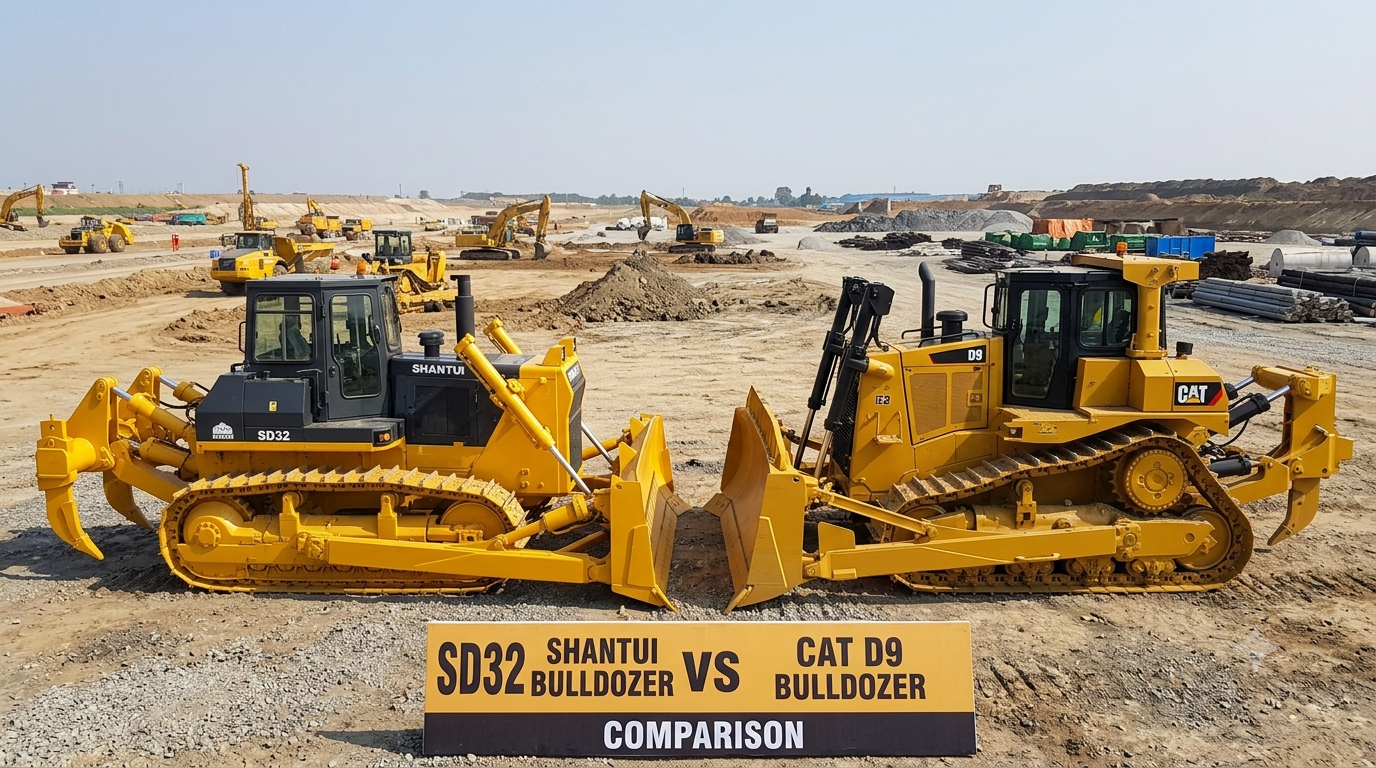
Shantui Bulldozer vs Caterpillar: Which Offers Better Value for Mining Operations?
When you’re outfitting a mining fleet, the bulldozer you choose affects your bottom line for the next decade — not just on the invoice, but in fuel burn, downtime, parts costs, and resale value. Two names come up constantly in these conversations: Shantui and Caterpillar (CAT).
This guide compares the two head-to-head using actual spec-class data and a full total cost of ownership (TCO) calculation, so you can size a machine and run the numbers yourself before you buy.
Note on figures: Specs below are class-representative ranges for large mining dozers (~350-450 hp). Confirm exact figures against the current spec sheet for the specific model/configuration you’re quoting — engine tier, blade type, and undercarriage option all shift these numbers.
Spec-Class Comparison: Large Mining Dozer (350–450 HP Class)
| Spec | Shantui SD32 Class | CAT D9 Class |
|---|---|---|
| Net power | ~320–350 hp (238–261 kW) | ~370–405 hp (276–302 kW) |
| Operating weight | ~40,000–43,000 kg | ~48,000–50,000 kg |
| Blade capacity (SU/S blade) | ~9.5–11.0 m³ | ~10.7–13.3 m³ |
| Ground pressure | ~0.85–0.95 kg/cm² | ~0.80–0.95 kg/cm² |
| Fuel tank capacity | ~600–650 L | ~800–870 L |
| Fuel consumption (avg loaded) | ~28–34 L/hr | ~32–38 L/hr |
| Undercarriage service life (design target) | ~8,000–10,000 hrs | ~10,000–12,000 hrs |
| List price (approx., FOB) | 55–65% of CAT equivalent | Baseline (100%) |
What this tells you technically:
- Power-to-weight ratio matters more than raw horsepower for cycle time. Shantui’s SD32-class sits around 8.0–8.7 hp/tonne; the CAT D9-class runs closer to 7.7–8.4 hp/tonne. These are close enough that cycle times on standard dozing passes (ripping, pushing, grading) are comparable within a single-digit percentage — not a material productivity gap for most mine-site applications.
- Blade-to-power ratio (blade capacity ÷ net power) is a rough proxy for material moved per hour at a given fuel burn. Both classes land in a similar 0.027–0.030 m³/hp band, meaning material-moving efficiency per horsepower is broadly equivalent.
- Ground pressure is nearly identical across both, so flotation on soft mine-bench material is not a meaningful differentiator.
Fuel Cost Calculation (Per Machine, Per Year)
Use this formula to model your own fuel cost:
Annual fuel cost = Fuel consumption (L/hr) × Operating hours/year × Fuel price ($/L)
Worked example (2,000 operating hours/year, diesel at $1.10/L — adjust to your local price):
- Shantui (31 L/hr avg): 31 × 2,000 × $1.10 = $68,200/year
- CAT (35 L/hr avg): 35 × 2,000 × $1.10 = $77,000/year
Difference: ~$8,800/year lower fuel cost on Shantui, roughly proportional to the ~11% lower average consumption in this class comparison. Over a 10-year operating life, that’s ~$88,000 in fuel savings alone — before accounting for purchase price or maintenance.
Maintenance Cost Calculation
A standard industry benchmark for large dozer scheduled maintenance (filters, fluids, ground-engaging tools, undercarriage wear items) is $8–14 per operating hour for CAT-class machines, and $6–10 per operating hour for Shantui-class machines, reflecting lower OEM parts pricing.
Annual maintenance cost = Maintenance rate ($/hr) × Operating hours/year
Worked example (2,000 hrs/year, mid-range rate):
- Shantui ($8/hr): 8 × 2,000 = $16,000/year
- CAT ($11/hr): 11 × 2,000 = $22,000/year
Difference: ~$6,000/year, or ~$60,000 over 10 years.
Undercarriage Replacement — A Major Line Item
Undercarriage (track chains, rollers, idlers, sprockets) is typically the single largest wear-cost component on a dozer and commonly runs 15–25% of a machine’s original purchase price per replacement, needed roughly every 8,000–12,000 hours depending on ground conditions.
At 2,000 hrs/year, that’s one undercarriage replacement every 4–6 years — so budget for 1–2 replacements across a 10-year working life, scaled to each machine’s purchase price (this is where CAT’s higher upfront cost compounds, since 20% of a larger number is a larger absolute cost).
Full 10-Year TCO Model
Assumptions used below: 2,000 hrs/year operation, $1.10/L diesel, actual Shantui SD32 purchase price of $275,000, illustrative CAT D9-class price for comparison, one undercarriage replacement at year 5.
| Cost Component | Shantui SD32 (actual price) | CAT D9-class (illustrative) |
|---|---|---|
| Purchase price | $275,000 | $370,000 |
| Fuel (10 yrs) | $682,000 | $770,000 |
| Scheduled maintenance (10 yrs) | $160,000 | $220,000 |
| Undercarriage replacement (1x, ~20% of price) | $55,000 | $74,000 |
| Total 10-yr cost of ownership | $1,172,000 | $1,434,000 |
| Estimated resale value at year 10 (~15% CAT / ~8% Shantui of original price) | $22,000 | $55,500 |
| Net 10-yr cost (TCO − resale) | $1,150,000 | $1,378,500 |
Net result: Even after giving CAT full credit for stronger resale retention, the Shantui SD32 comes out ~16.6% cheaper over a 10-year working life in this model — roughly $228,500 in savings per unit. Multiply that across a 5-unit fleet and the gap becomes a ~$1.14M total cost difference.
CAT figures above remain illustrative for comparison purposes — swap in an actual competitive quote from your market if you have one, and the Shantui column will stay accurate at the confirmed $275,000 price point.
Which Should You Choose?
- Choose CAT if resale liquidity in a mature secondary market outweighs a 20%+ TCO premium for you, or your operating region has significantly better CAT parts lead times than Shantui.
- Choose Shantui if you’re running machines to full depreciation, optimizing for lowest cost-per-operating-hour, or scaling a multi-unit fleet where the per-unit savings compound quickly.
For most mining and heavy-construction operations running equipment on a full working-life cycle rather than a short resale cycle, the TCO math favors Shantui by a wide and calculable margin.
Frequently Asked Questions
How do I calculate total cost of ownership for a dozer myself?
Sum purchase price + (fuel rate × hours/year × years) + (maintenance rate × hours/year × years) + expected undercarriage replacements, then subtract estimated resale value at your planned sell/retire year. Use your actual quoted price and local fuel cost rather than the illustrative figures above.
What’s a normal fuel consumption rate for a large mining dozer?
For 350–450 hp class dozers running loaded dozing cycles, expect roughly 28–38 liters/hour depending on load factor, blade type, and ground conditions. Ask your dealer for load-factor-adjusted consumption data from the specific model’s spec sheet.
How often does undercarriage need replacing on a mining dozer?
Typically every 8,000–12,000 operating hours, though abrasive ground conditions (hard rock, high-silica material) can shorten that interval by 20–30%. Undercarriage cost is normally 15–25% of the machine’s original purchase price per replacement.
Is Shantui’s lower fuel consumption due to a smaller engine or better efficiency?
Largely displacement and horsepower class — Shantui’s SD32-class runs a somewhat smaller-displacement engine than the CAT D9-class, which is part of why both fuel burn and blade capacity are proportionally lower. Per-horsepower efficiency is broadly comparable between the two.
Does a lower purchase price mean lower quality on Shantui machines?
Not necessarily — a lower price primarily reflects lower manufacturing and labor costs, established supplier relationships (many components sourced from global-tier suppliers), and lower brand-premium markup rather than a proportional cut in build quality. Confirm engine, transmission, and hydraulic component sourcing on the specific model you’re quoting.
How do I model this for a fleet instead of a single machine?
Multiply the per-unit net TCO difference by the number of units, but also re-run maintenance costs at fleet scale — bulk parts contracts often improve per-hour maintenance rates by 10-15% regardless of brand, so get a fleet-volume quote from your dealer before finalizing the comparison.
Want a TCO model built around your actual fleet size, operating hours, and local fuel cost? Contact our team for a custom cost comparison and spec sheet on Shantui dozers sized for your operation.